
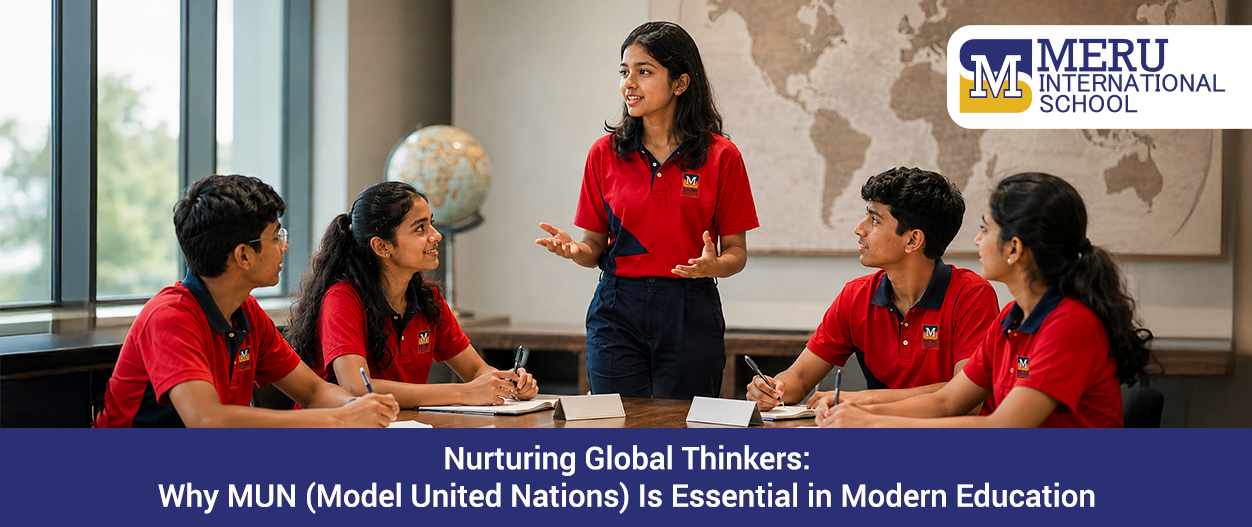
Nurturing Global Thinkers: Why MUN (Model United Nations) Is Essential in Modern Education
In the current era, where everything seems to be interconnected, the concept of education has evolved from reading books and taking exams. For students to learn the skills of leadership, communication, negotiation, and problem-solving, there is no better way than engaging in MUN.
The importance of MUN in education arena has become prominent in recent times. The students get to engage in debates, negotiations, decision-making, and discussions on international relations via simulations of various committees of the UN. For students who engage in MUN, it helps them develop life skills and also makes them globally aware.
In light of the increasing emphasis placed by schools on the holistic development of students, the significance of MUN in education is now more effective than ever.
Introduction to Model United Nations (MUN)
Model United Nations is an academic program where participants simulate UN meetings and act as delegates who represent various countries and tackle global challenges in a planned manner.
Participants debate issues such as the following:
- Climate change
- Human rights
- Security
- Global health
- Development
- Trade
Students research the policy of their chosen country and will come up with solutions in the form of speeches and resolutions.
The main goal of MUNs for students is to instill knowledge of international relations along with skill development, which will prove useful in life.
Unlike traditional classroom teachings, MUN provides an avenue where learners get involved through interactions, collaboration, and critical thinking processes. This helps them to understand complex matters from different viewpoints and try to solve them.
How MUN Develops Leadership, Communication, and Critical Thinking Skills?
Some of the advantages of MUN are that one learns vital skills such as leadership and communication.
Leadership Skills for Students
Modern organisations seek individuals who can lead teams, solve problems, and make important decisions.
MUN helps students develop:
- Decision-making Skills
- Responsibility and Accountability
- Management of Teams
- Strategic Thinking
- Leadership Confidence
Through participating in committee discussions as delegates, they learn to influence others’ viewpoints and engage in constructive debates.
Public Speaking Skills for Students
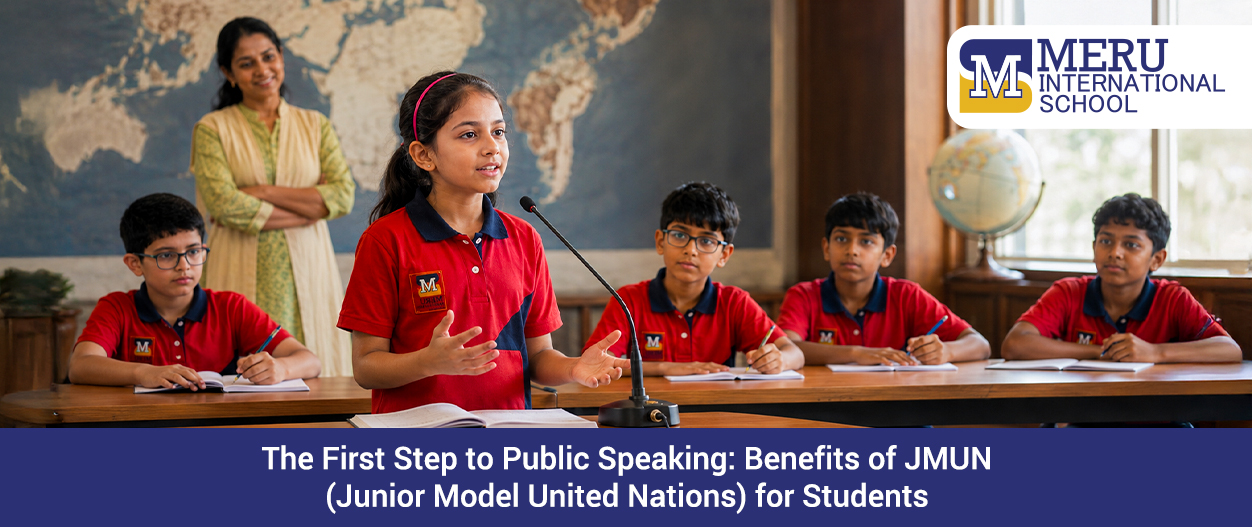
Public speaking fear is prevalent amongst the learners. The MUN provides a good environment whereby the speakers get to deliver speeches and stand their ground.
Consistent participation enables the students to develop skills in:
- Speech delivery
- Voice modulation
- Confidence
- Persuasive communication
- Presentation skills
These public speaking skills amongst the students become relevant in learning and career.
Critical Thinking Skills for Students
Global challenges rarely have simple solutions. MUN encourages students to evaluate multiple viewpoints and formulate balanced responses.
This strengthens:
- Analytical reasoning
- Problem-solving abilities
- Logical thinking
- Research skills
- Decision-making capabilities
Developing critical thinking skills for students is essential in preparing them for future academic and professional success.
The Role of MUN in Building Global Awareness and Diplomacy
Understanding international affairs is becoming increasingly important in a rapidly globalising world.
Global Education for Students
One of the biggest strengths of MUN is fostering global education among young students.
Students get an opportunity to learn about:
- International relations
- Global governance
- Cultural diversity
- Economic policies
- Humanitarian problems
They become better aware of what is happening around the world.
Understanding Diplomacy
Peaceful diplomacy is the backbone of international cooperation.
Students get to learn through MUN:
- Negotiation
- Conflicts solving
- Building consensus
- Effective communication
- Cultural understanding
This will make students understand the significance of diplomatic means when handling global issues.
Developing Responsible Global Citizens
Model United Nations teaches students to be proactive members of the community. Students realise that there is a need for collective problem-solving when it comes to global problems.
Therefore, they become more empathic, knowledgeable, and socially conscious.
Benefits of Model United Nations Participation for Academic and Career Growth
MUN provides many more advantages than merely classroom-based learning.
Academic Advantages
Benefits of learning from participation in MUN include:
- Better research skills
- Improved writing abilities
- Increased reading comprehension
- Enhanced analytical thinking skills
- Broad general knowledge
They become better and more engaged students in class.
University Applications
Extracurricular activities that show evidence of leadership, initiative, and curiosity are highly valued in many universities.
Participation in MUN improves university applications through the following:
- Leadership skills
- Public speaking skills
- World consciousness
- Team player skills
- Commitment for learning
Career Development
Today’s employers prefer professionals with good communication skills, problem-solving skills, and the ability to work in different environments.
The skills gained through MUN for students are highly transferable to careers in:
- Law
- International relations
- Public policy
- Business management
- Journalism
- Diplomacy
- Corporate leadership
Building Professional Confidence
Active involvement in debates and negotiations assists students in becoming comfortable with the presentation of their ideas and views.
This confidence often translates into stronger academic and professional performance later in life.
Why MUN Is an Essential Part of Modern Education?
The challenges of the 21st century mean that students need much more than bookish knowledge.
The educational system of the modern day needs to concentrate on the following:
- Leadership skills of the students
- Public speaking skills of the students
- Critical thinking skills of the students
- Teamwork skills
- Worldliness
MUN combines all these skills in one learning platform.
Preparing Students for Global Challenges
Future leaders should know about international problems and operate in a multicultural environment.
The significance of Model United Nations (MUN) in the educational process is that it prepares people for these challenges and promotes life-long learning.
Encouraging Active Learning
Students change from being mere learners to active participants through MUN. Instead of learning by heart what is taught, the students:
- Research on their own
- Analyze world problems
- Find solutions
- Make presentations
- Work together with other students
This process helps develop better comprehension and retention of information.
Holistic Development
More educational institutions are realising the significance of raising individuals who have all-rounded skills.
Some of the schools like Meru International School work very hard to foster programs that assist in fostering leadership skills, communication skills, and global citizenship skills.
Conclusion
The increasing trend of MUN (Model United Nations) demonstrates its tremendous worth in contemporary education. Students develop various qualities such as leadership skills, diplomatic skills, self-confidence, and knowledge about international affairs by participating in Model United Nations.
The many advantages that MUN offers include better communication, improved critical thinking skills, superior academic performance, and increased career preparedness. All of these contribute to making students well-informed, responsible, and able global citizens.
While the focus of education keeps changing, educational institutions like the Meru International School have realised that there is a need for activities that go beyond just studying. Through the encouragement of MUN, they ensure that the young people acquire the requisite knowledge and leadership skills needed for today’s world
Comments
No comments available.
Post a Comment