
Exam Stress
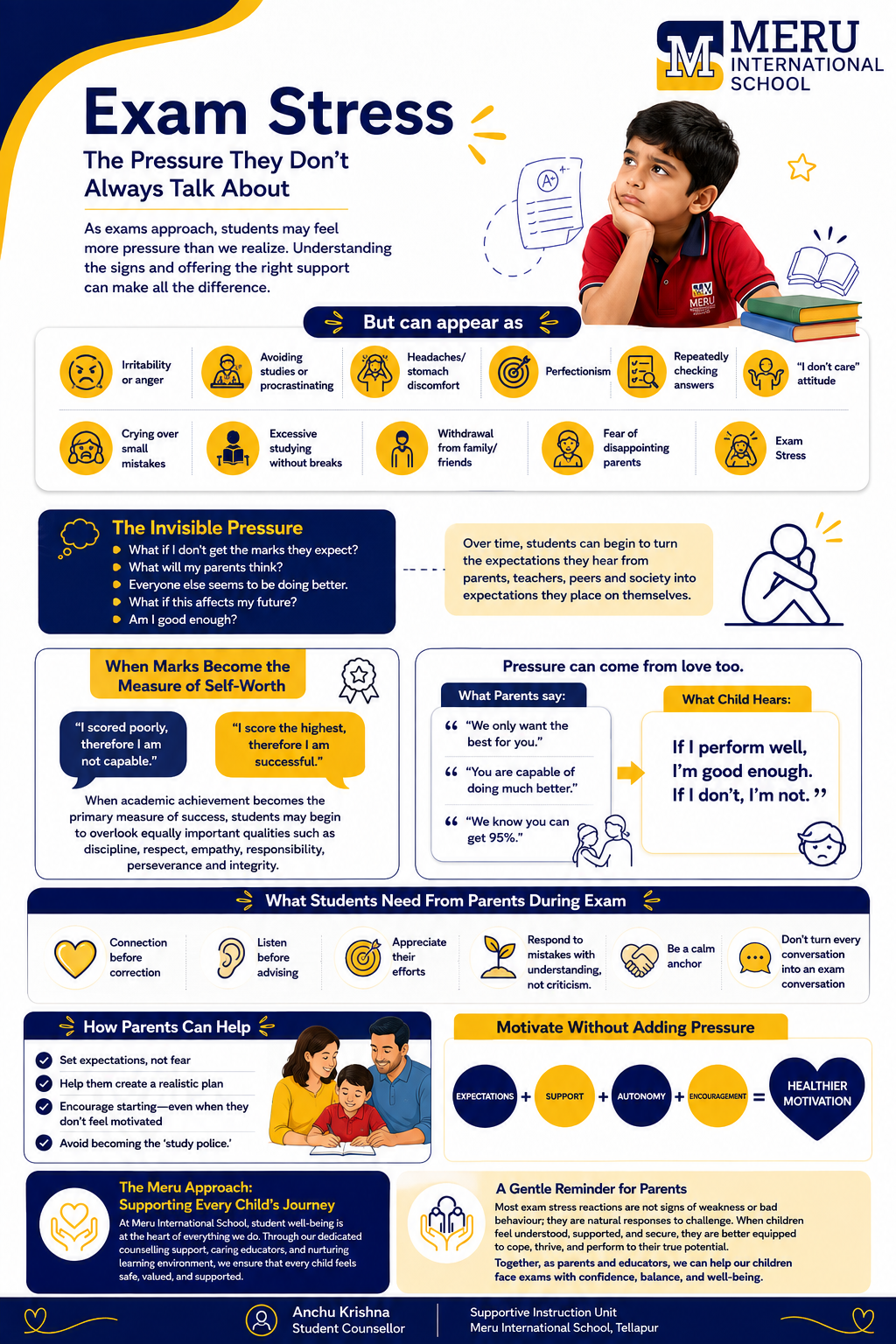
As exams approach, students may feel more pressure than we realise. Understanding the signs and offering the right support can make all the difference. This post — written by Meru's student counsellor Anchu Krishna — addresses what exam stress actually looks like, why it forms, and what children genuinely need from the adults around them.
Exam stress is not always what it looks like
Most parents scan for obvious signals — a child crying at their desk, refusing to study, or visibly distressed. But exam stress in children, especially from around age 10 onwards, is far more likely to present in disguised, mislabelled, or easily dismissed ways. Recognising it accurately is the first step toward responding to it well.
The child who appears "fine" is often the one carrying the most. Children who manage their emotions outwardly — who go to school, attend tuition, and maintain a surface-level normal — can be running on an internal stress load that only becomes visible when it tips over.
The 10 Signs of Exam Stress Parents Most Commonly Miss
These are not the dramatic signs. These are the ones that get explained away as personality, laziness, a phase, or something the child will grow out of — until they don't.
|
1 |
Irritability or anger The child snaps at family members or has meltdowns over minor issues. This is the stress finding an outlet — not a discipline problem. |
|
2 |
Avoiding studies or procrastinating A highly stressed student often cannot start. The fear of failure makes beginning feel impossible — avoidance is self-protection, not laziness. |
|
3 |
Headaches and stomach discomfort on school days The gut-brain connection is real and well-documented. Recurring physical complaints that vanish on weekends are almost always anxiety, not illness. |
|
4 |
Perfectionism Erasing and rewriting repeatedly, refusing to submit 'imperfect' work, spending disproportionate time on single tasks — all markers of performance anxiety, not dedication. |
|
5 |
Repeatedly checking answers Checking the same answer five times is not diligence — it is anxiety seeking reassurance that never fully satisfies. The checking itself becomes compulsive. |
|
6 |
An apparent 'I don't care' attitude Indifference is often a protective strategy. If I say I don't care, failing cannot hurt me. This is one of the most misread signals in adolescent exam stress. |
|
7 |
Crying over small mistakes A disproportionate response to a minor error reveal that the child's sense of self-worth has become tightly bound to performance. This is a significant flag. |
|
8 |
Excessive studying without breaks Studying six or more hours without rest is not discipline — it is anxiety-driven compulsion that paradoxically reduces learning efficiency and retention. |
|
9 |
Withdrawal from family and friends Social withdrawal during exam season signals a child managing overwhelming internal pressure without adequate support. Isolation amplifies the stress. |
|
10 |
Fear of disappointing parents The heaviest weight a child carries is not the syllabus — it is the imagined expression on a parent's face after results. This fear is often more paralysing than the exam itself. |
The Invisible Pressure: What Children Are Actually Thinking
The most damaging exam stress is not in the study schedule — it lives in the questions children ask themselves silently, alone, often in the dark before sleep. These are the thoughts that never make it into a parent-child conversation because the child has no language for them, or because they fear the answer.
"What if I don't get the marks they expect?"
"What will my parents think?"
"Everyone else seems to be doing better."
"What if this affects my future?"
"Am I good enough?"
Over time, students can begin to turn the expectations they hear from parents, teachers, peers and society into expectations they place on themselves. The external pressure becomes internal — and internal pressure has no off switch
This internalisation process is the reason why reducing exam pressure requires more than telling a child to 'relax.' By the time the stress is visible, the child has often already constructed an entire internal narrative around performance and worth that a single reassuring conversation cannot dismantle.
When Marks Become the Measure of Self-Worth
This is the central psychological mechanism behind most severe exam stress — and the one most often unaddressed in school and home environments.
|
"I scored poorly; therefore, I am not capable." |
"I score the highest, therefore I am successful." |
Both of these beliefs are distorted — and both are damaging. The child who defines themselves by low scores develops shame and avoidance. The child who defines themselves by high scores develops fragility and performance anxiety — because their entire sense of self depends on maintaining a standard they cannot always control.
When academic achievement becomes the primary measure of success, students may begin to overlook equally important qualities such as discipline, respect, empathy, responsibility, perseverance and integrity. These are the qualities that determine life outcomes far more than any exam score.
Pressure Can Come from Love Too
The pressure that causes the most lasting damage to children is often not the kind that comes from indifference or harshness — it is the pressure embedded in love, concern, and genuine hope for the child's future.
|
What Parents Say: "We only want the best for you." "You are capable of doing much better." "We know you can get 95%." |
What the Child Hears: "If I perform well, I am good enough. If I don't, I am not." |
The translation is not what the parent intended — but it is what the child receives, because children do not yet have the cognitive and emotional development to fully separate conditional statements from conditional love. Statements of capability ('you can do better') are heard as statements of current inadequacy ('you are not doing enough').
What Students Actually Need from Parents During Exam Season
Research in child psychology and educational neuroscience is consistent on this: children perform better under pressure when they feel securely connected to their parents — not when they feel evaluated by them. Connection is not a soft extra. It is the neurological precondition for the kind of focused, resilient learning that exam performance requires.
|
1 |
Connection before correction Before addressing what went wrong academically, connect with how your child is feeling. The relationship is the foundation on which everything else rests. |
|
2 |
Listen before advising When a child says 'I can't do this,' they need to feel heard — not immediately handed a solution. Feeling heard reduces the cortisol load that is blocking their thinking. |
|
3 |
Appreciate their efforts Effort is entirely within a child's control. Outcomes are not. Consistently recognising effort over outcome separates healthy motivation from performance anxiety. |
|
4 |
Respond to mistakes with understanding, not criticism A mistake corrected in a climate of understanding produces learning. A mistake criticised in a climate of shame produces emotional shutdown — the opposite of learning readiness. |
|
5 |
Be a calm anchor Your emotional regulation during exam season directly affects your child's. Parental anxiety about results is biologically contagious. So is calm, confident presence. |
|
6 |
Don't turn every conversation into an exam conversation Children need to know that your interest in them extends beyond their academic performance. Dinner table conversations about anything non-academic are investment in the relationship that supports exam performance. |
How to Motivate Without Adding Pressure
There is a meaningful difference between pressure that motivates and pressure that paralyses. The former comes with support, autonomy, and genuine encouragement. The latter comes with fear, surveillance, and conditional approval.
✓ Set expectations, not fear. High expectations communicated with warmth and confidence motivate. Communicated with anxiety and criticism, they paralyse.
✓ Help them create a realistic study plan. A written, time-bound plan reduces the overwhelming feeling that makes starting impossible. Planning together — not for them — builds ownership.
✓ Encourage starting, even when they don't feel motivated. Motivation typically follows action, not the other way around. Five minutes of actual work usually produces more engagement than 30 minutes of waiting to feel ready.
✓ Avoid becoming the 'study police.' Constant checking, questioning, and reminding shifts the locus of responsibility from the child to you — and breeds both resentment and learned helplessness.
EXPECTATIONS + SUPPORT UTONOMY + ENCOURAGEMENT = HEALTHIER MOTIVATI
A Gentle Reminder for Parents
Most exam stress reactions are not signs of weakness or bad behaviour — they are natural responses to challenge. When children feel understood, supported, and secure, they are better equipped to cope, thrive, and perform to their true potential. Together, as parents and educators, we can help our children face exams with confidence, balance, and well-being.



Comments
No comments available.
Post a Comment