
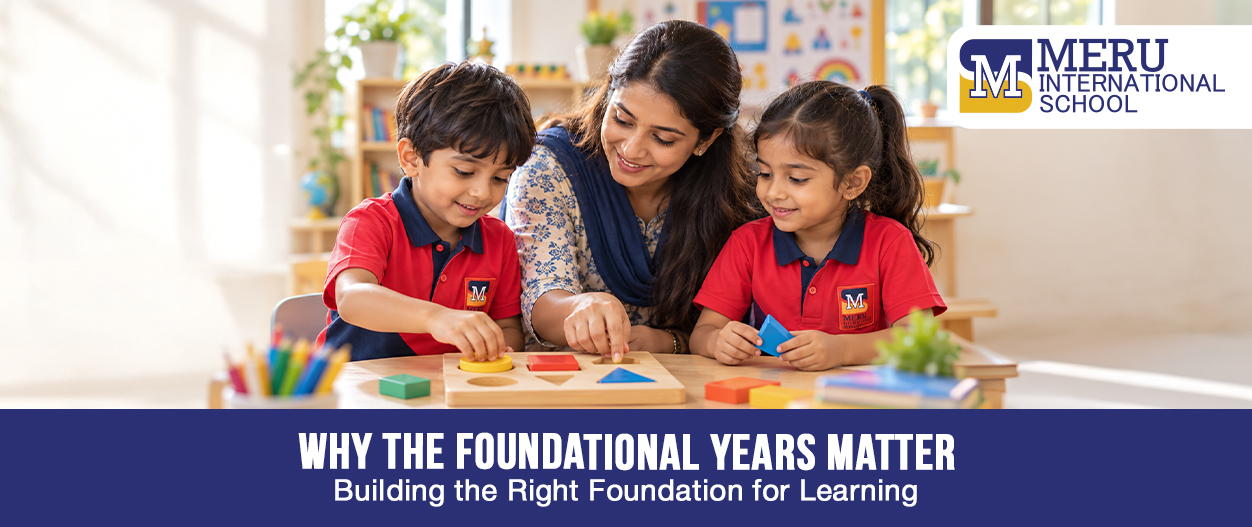
Why the Foundational Years Matter: Building the Right Foundation for Learning
The foundational years are an important stage in a child's education. Between the ages of 3 and 8, children begin developing early literacy and numeracy skills, but that is only one part of what they are learning. They are also learning to communicate, ask questions, interact with others, solve problems, express themselves and become comfortable with learning.
For parents, this makes the early years an important time to think carefully about the school environment their child will experience.
What Are the Foundational Years?
In India's education framework, the Foundational Stage covers children from ages 3 to 8, including three years of early childhood education followed by Grades 1 and 2. It focuses on foundational literacy and numeracy along with physical, cognitive, social, emotional and communication development.
Young children also learn differently from older students. A child may understand an idea better by touching, building, talking, drawing or experimenting than by simply listening to an explanation.
This is why foundational learning is not only about introducing children to reading, writing and numbers. It is also about giving them opportunities to explore, communicate, participate and gradually develop confidence in their ability to learn.
Why Are the Foundational Years Important?
Building the foundations of literacy and numeracy
Learning to read, write and work with numbers is an important part of the early years.
Children begin developing language, vocabulary, reading comprehension, writing and mathematical understanding. These skills become building blocks for learning across subjects as they progress through school.
India's NIPUN Bharat mission also places strong emphasis on foundational literacy and numeracy as essential learning outcomes for children.
But developing these skills does not have to mean making early learning feel like formal academics all the time.
For young children, stories, conversations, games, activities and hands-on experiences can all become part of learning.
Developing an approach to learning
Young children naturally ask questions.
Why does this happen? What will happen if I try this? Can I do it another way?
The foundational years are an opportunity to nurture that curiosity.
When children are encouraged to observe, explore, experiment and discuss, they begin to understand that learning is something they participate in rather than something they simply receive.
This is an important part of foundational learning for children because the early school experience can influence how comfortable they feel with asking questions, trying something new and solving problems.
Building confidence through everyday experiences
Confidence in a young child is not built only through praise.
It can develop through small experiences repeated every day.
Answering a question in class. Talking to a new friend. Showing others something they have created. Trying an activity for the first time. Making a mistake and trying again.
These experiences can gradually help children become more comfortable expressing themselves, participating in a group and taking on something unfamiliar.
Children need opportunities to participate, not just opportunities to listen.
Learning through people and experiences
A classroom is more than a place where a teacher delivers a lesson.
Children learn by watching their teachers, talking to classmates, working together, listening to stories, participating in activities and exploring their surroundings.
Storytelling can support language and imagination. Role play can encourage communication. Collaborative activities can help children learn to listen and work with others. Hands-on experiences can help them connect ideas with the world around them.
These experiences may look simple to an adult, but for a young child, they can become meaningful learning moments.
What Should Parents Look for When Choosing a School for the Foundational Years?
When parents visit schools during the admissions process, it is natural to notice the campus, classrooms, facilities, curriculum and activities.
All of these are relevant.
But when choosing a school during the foundational years of education, it can also help to look closely at what children actually experience during a normal school day.
Look at how children learn
Are children given opportunities to ask questions, explore and discuss? Or is most of the learning based on listening, copying and completing worksheets?
Structured learning has its place, but young children also need opportunities to engage with what they are learning.
Observe the teacher-child interaction
Watch how teachers speak to children.
Do they listen to questions? Do they encourage children to participate? Do they give children time to think and respond? Do children feel comfortable approaching them?
The relationship between a teacher and child can influence how comfortable a young learner feels in the classroom.
Ask how literacy and numeracy are taught
Instead of only asking whether a school teaches reading, writing and mathematics, parents can ask how children develop these skills.
Do children get opportunities to use language in conversations and stories? Do they explore numbers through activities and practical experiences? How does the school support children who learn at different paces?
These questions can give parents a better understanding of the learning experience than a curriculum name alone.
Look beyond academics
The foundational years are also a time for children to develop communication, creativity, social skills and confidence.
Look at the opportunities available for art, music, movement, play, collaboration, projects and exploration.
These experiences do not take away from academic learning. They can become part of how young children understand and engage with the world around them.
Most importantly, watch the children
During a school visit, spend some time observing the children.
Are they engaged? Are they interacting with their teachers? Are they talking to one another? Do they seem comfortable participating? Are they given opportunities to explore and create?
A school brochure can tell you what a school offers. Watching a classroom can help you understand how that offering comes alive.
Looking at these details can help parents make a more informed decision about their child's early learning environment.
How Does Meru International School Approach Foundational Learning?
At Meru International School, the Foundation Stage covers EY1 to Grade II for children aged 3 to 8.
For the Early Years, Meru follows the Cambridge Early Years programme with a play-based and interactive approach. Learning experiences include storytelling, hands-on activities, collaborative projects, role play and teamwork.
As children move into Grades I and II, Meru follows a blend of Cambridge primary programmes with CBSE primary learning outcomes. The learning areas include literacy, numeracy, science and environmental education, global perspectives, digital literacy, languages, arts, and personal, social and physical education. Active enquiry is also part of the learning approach.
This approach gives children opportunities to build foundational academic skills while continuing to explore, communicate, participate and develop their understanding through meaningful experiences.
a parent quote, a teacher quote, or a specific classroom moment
Example: "My daughter asks 'why' about everything now, and her teachers actually let her find out." — Parent, Grade I, Meru [Campus]
Curious what a typical day in Meru's Foundation Stage looks like? Take a closer look at how EY1–Grade II classrooms bring this approach to life →
The Foundation Years Deserve a Closer Look
Choosing a school for the foundational years is about more than selecting a curriculum.
It is about understanding the kind of learning environment your child will experience every day.
Will your child have opportunities to ask questions and explore? Will they receive support as they develop early academic skills? Will they be encouraged to communicate and participate? Will learning include experiences that make ideas easier for a young child to understand?
These are worth considering alongside academics, infrastructure, location and other practical factors.
A school visit gives parents an opportunity to move beyond what is written in a brochure and see the learning environment for themselves.
The best way to see this in practice is to spend a few minutes in a Meru classroom. Book a walk-through and watch how children learn, ask, and participate →
Comments
No comments available.
Post a Comment