
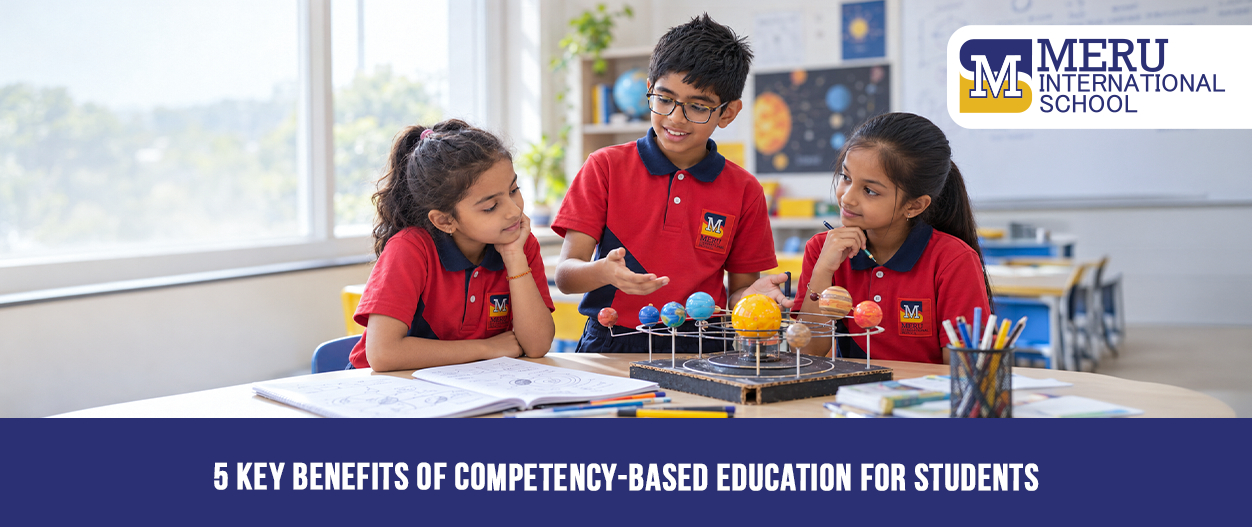
5 Key Benefits of Competency-Based Education for Students
The idea of learning has become much more complex than mere reading, tests and memorisation. The new approach to education pays attention to skills development, problem solving, creativity and personal growth of students. Competency Based Education is one of the types of education that concentrates not on the period of time spent by students on particular subjects, but on their knowledge and abilities.
There are a number of benefits that the concept of Competency-Based Education offers including personalised learning, skill building, better understanding and increased motivation of learners.
Inquiry-based learning, experiential learning and skill building are the main elements of MERU International School's educational approach.
What Is Competency-Based Education?
Competency-based education (CBE) is an educational methodology that focuses on the acquisition of certain knowledge, skills, and competencies by the learner.
Unlike conventional educational methodologies that usually follow certain instructional timetables, competency-based methodologies focus on assessing the capability of the learners to practically apply their knowledge through certain tasks.
In such a case, instead of focusing on remembering formulas in mathematics, the learner solves problems based on certain measurements and computations.
In MERU International School, inquiry-based learning and practical educational experiences ensure that necessary competencies are developed along with academic knowledge.
How Does Competency-Based Learning Work?
Learning through competency starts by outlining the intended learning objectives and the skills that the learners should acquire.
The teachers go ahead to create experiences for the learners to demonstrate their level of comprehension.
Competency-based learning is normally achieved by:
- Outlining competencies: Setting learning objectives.
- Teaching: Through class discussions, projects, and hands-on experiences.
- Testing understanding: Through tests, assignments, and assessments.
- Providing feedback: Spotting weaknesses that need improvement.
- Mastery of concepts: Letting the learners apply what they have learned.
Competency learning does not only focus on testing but also focuses on measurable learning results from the learners.
Mastery-Based, Self-Paced Progression
Mastery progression is another crucial characteristic of Competency-Based Education.
The learners are given chances to develop better comprehension skills before going to the next level of more difficult lessons.
A case in point would be the learner who is studying fractions and needs more practice before taking up complicated math problems.
It is not the same for all learners to progress at the same pace.
In a school setting, self-paced progression does not automatically mean the learner progresses to the next grade by himself or herself.
Truly Personalised Learning Paths
All learners have their own strengths and areas of interest.
Personalised education can help teachers customise their teaching approaches based on the needs of the learners.
Some learners will understand when concepts are presented visually, while others will do better through practical work and discussions.
Inquiry, participation, and reflection at MERU are learner-based approaches to education.
Personalisation can boost self-confidence and provide academic assistance to the learners.
5 Key Benefits of Competency-Based Education for Students
1. Encourages Critical Thinking and Problem-Solving
Thinking analytically is another strength attributed to Competency Based Education.
Rather than just rote learning the right answer, students are made to question their perspectives and solve the problems that they have.
For example, in a science lesson on saving water, students learn to think about environmental problems and find ways to solve them.
Thus, this is one way that helps students develop critical thinking skills in new situations.
The inquiry-based approach at MERU School is another example of such education.
2. Supports Personalised Learning
The competence-based models recognise the fact that different students need different types of help to accomplish the same results.
Using personalised learning, teachers are able to recognise the learning gap and give proper help.
Those students who show high levels of understanding will receive enrichment programs, whereas those who need additional help will be allowed to revise the concepts.
Hence, learning can happen without putting any kind of pressure of competition on the students.
3. Builds Practical, Real-World Skills
Theory and practice integration is done through skill-based learning.
Skill-based learning involves the learners learning the skills of communication, collaboration, decision-making, and problem solving.
This can be achieved by ensuring that the whole class gets involved in the process of setting up a business in the classroom hence learning the skills of budgeting, collaborating, planning, and presenting.
Experiential learning will help in the achievement of this goal through giving the learners the chance to learn skills through doing, observing, reflecting, and applying.
MERU International School employs experiential learning and inquiry-based teaching in skill-based learning.
4. Improves Student Engagement and Confidence
When the students have knowledge about the purpose of learning, they get interested in the process of learning.
Competency-Based Education makes learning interesting through discussion, project, and activities.
Through the activity based learning, the students get the chance to learn everything by themselves rather than becoming receivers of information.
Involving in the activities and receiving feedback may help in motivating and boosting their confidence level.
MERU helps in engaging, collaborating, and thinking critically in the student-centered learning approach.
5. Promotes Deeper Understanding and Knowledge Retention
Learning using memorisation would assist the learner to remember the answer temporarily, but application could help gain more understanding.
Competency-based approach uses practice, reflection, and application of knowledge.
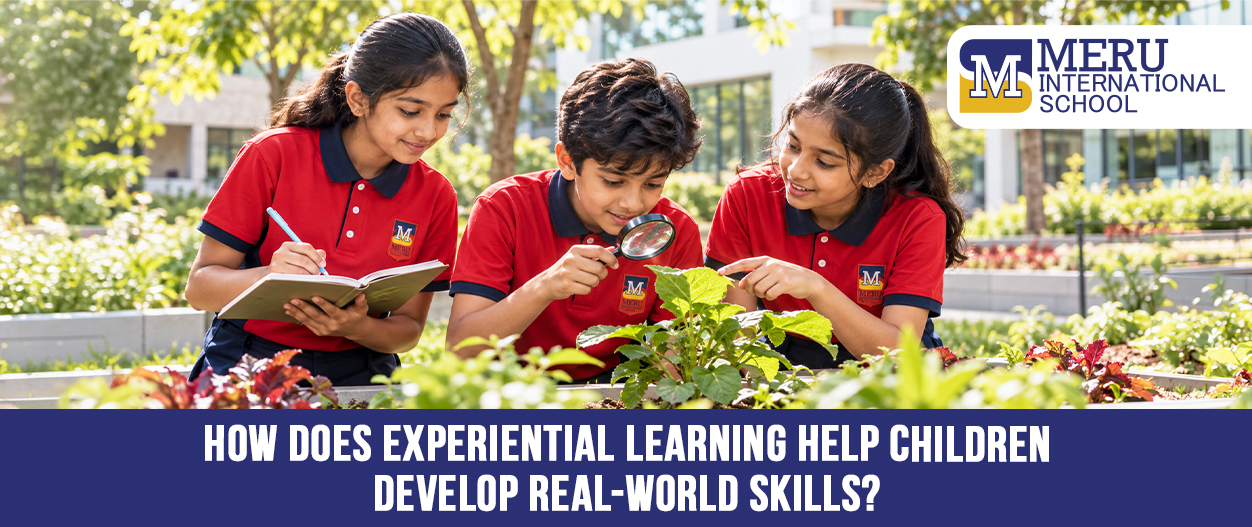
For instance, if learners learn about the growth of plants, they can go ahead and plant the plants, watch their growth, and record it.
It will be easier for them to relate the theory to the results achieved.
Competency-Based Education vs Traditional Learning
Being aware of these differences allows parents to be aware of how learning processes affect student development.
|
Factors |
Competency-Based Education |
Traditional Learning |
|
Primary focus |
Demonstrated understanding and skills |
Curriculum coverage and assessments |
|
Learning progression |
Based on mastery of competencies |
Often follows fixed schedules |
|
Teaching approach |
Flexible and learner-centred |
Commonly teacher-directed |
|
Assessment |
Continuous demonstrations and feedback |
Often emphasises periodic examinations |
|
Student participation |
Active learning and application |
Varies by teaching method |
|
Student learning outcomes |
Specific measurable competencies |
Curriculum-defined academic achievement |
|
Practical application |
Explicitly integrated |
Depends on classroom practices |
There is also traditional education, which can include projects, personalised learning, and hands-on activities. The difference is that Competency-Based Education relies on achieving mastery.
How MERU Encourages Competency-Oriented Learning?
Inquiry-based learning, practical learning and skill-based learning are some of the approaches adopted by MERU International School in its mode of teaching.
The courses taught at MERU include the Cambridge Early Years program, a mixed approach in the case of the primary years, and CBSE and Cambridge programs in higher grades.
Another strength of MERU is its focus on communication, collaboration, creativity and problem-solving.
One of the ways this happens is through initiatives like M-CLAP, the school's career readiness and enrichment program, where students are provided with an opportunity to build their skills.
These are some of the key concepts associated with competency-based education.
Conclusion
Through Competency-Based Education, students are taught to go beyond rote learning and attain real understanding through practical application and personalized learning and improvement.
Some of the important advantages of Competency-Based Learning are enhanced critical thinking skills for students, increased engagement, development of practical skills, and deep conceptual understanding.
At MERU International School, there is inquiry-based learning, experiential learning, and skills-based learning programs that make up an enabling learning environment for curiosity and creativity.
MERU International School makes use of academic principles along with meaningful learning opportunities for students to become successful learners in the future.
To find out more about MERU International School, its curriculum and its learning programs, visit MERU International School

Comments
No comments available.
Post a Comment