
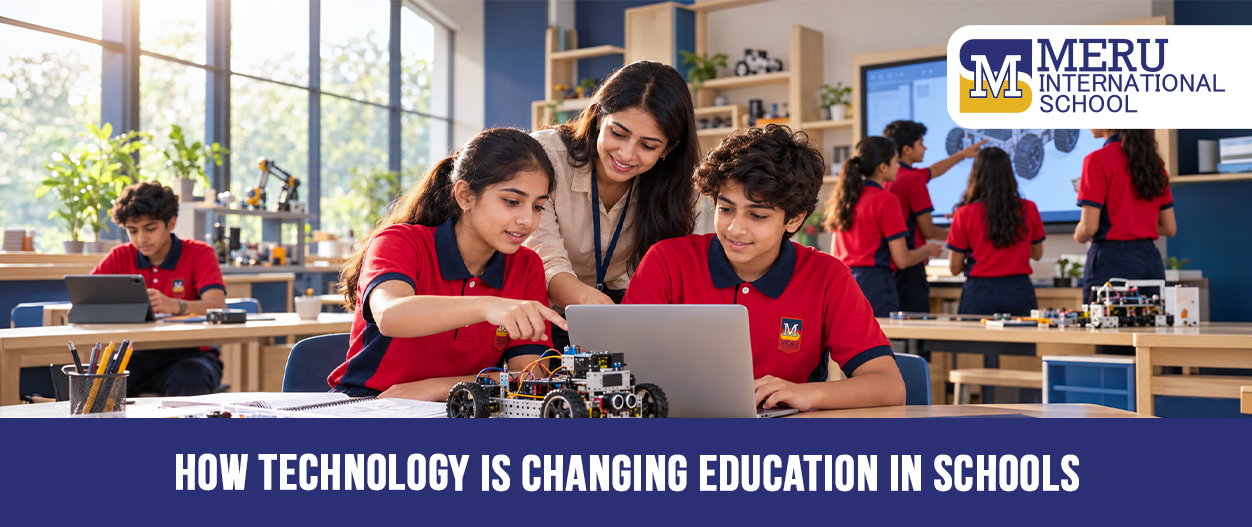
How Is Technology Changing Education in Schools?
How technology is changing education? Technological innovations have changed the process of learning, teaching, and running educational institutions. With the advent of digital classrooms and learning aids powered by artificial intelligence, the role of technology in modern education has grown significantly. The influence of technology on education can be observed in classrooms at all academic levels, assisting educational institutions in building more flexible learning environments.
Technology is no longer confined in the education sector to just computers or projectors. Today’s students have access to many digital resources, educational applications, virtual simulations, online tests, and artificial intelligence-based tutoring software. If used wisely, these tools can be helpful to both the teacher and the students in their own ways.
The Growing Use of Technology in Schools
Technology has been greatly integrated into the school setting. Textbooks and class lectures have been complemented with technology such as digital materials, learning management systems, interactive whiteboards, instructional videos, and collaborative technologies.
For instance, a science teacher can use a simulation to illustrate how the solar system works, while the mathematics teacher uses interactive tasks to enable students to understand difficult theories. Students also access learning materials from outside the classroom, giving them an opportunity to study on their own time.
This is especially important considering that not all learners learn things in the exact same way and pace. Technology gives teachers the added advantage of addressing these issues.
Understanding the Impact of Technology on Education
Technology not only makes learning more exciting but also affects other areas such as accessibility, personalisation, collaboration, assessment, and communication.
|
|
|
|
|
|
|
|
|
|
|
|
|
|
|
|
|
|
|
|
|
|
|
|
|
|
|
|
Nonetheless, access to technology alone does not ensure its usefulness. The schools should have the necessary infrastructure, training for the teachers, proper learning goals, and so forth.
Benefits of Technology in Education
One of the primary advantages of technology in education is increased access to learning materials. Using technologies such as digital libraries, educational websites, videos, and interactive media, students can study any subject that goes beyond the scope of one book.
In addition, technology can assist in the process of individualised education. Some educational websites evaluate students' results and suggest exercises based on the weak areas of their work.
Some other advantages might include:
- Greater access to multimedia learning materials
- More chances for self-directed learning
- More efficient feedback on specific tasks
- Increased communication between schools, teachers, students, and parents
- More interactive class activities
- Better monitoring of students' progress
- Increased accessibility for some students
All the above-listed advantages can depend on the quality of technological implementation.
Digital Learning in Schools
Digital learning has become an essential aspect of modern learning. Digital learning goes way past watching videos or completing worksheets online.
Digital learning may include the following:
- Learning management systems
- Educational interactive software
- Virtual labs and simulations
- Online homework and assessment
- Online library
- Educational games
- Videos for lessons
- AI-based learning software
Blended learning will be a combination of traditional learning in person and digital learning. This way, teachers can still keep face-to-face interaction while using technology for learning beyond the class.
Educational Technology in Classrooms
Educational technologies in the classroom can alter how lessons are taught. Interactive whiteboards can allow teachers and students to engage with visual information, while collaboration platforms can allow students to be part of group projects.
For teachers, technology can also minimise the amount of time spent on particular administrative tasks. Technology may help with making resources, planning assignments, monitoring students' progress, and recognising where students need extra help.
However, the teacher is at the core of the educational experience. While technology provides data and tools, teachers give context, encouragement, management, discussion, mentoring, and judgment.
The Role of AI in Modern Education
However, AI is growing increasingly prevalent in educational technology. For instance, it can be utilised to create personalised exercises, generate learning materials, give explanations, analyse student feedback, and help teachers in some tasks.
One type of AI-based technology is an AI tutor. Instead of giving each student the same content, the AI tutor could take into account the student's response data to modify activities for him/her.
What is an AI tutor, and how does it work?
An AI tutor is an automated software tool that uses artificial intelligence for learning purposes. It might answer questions, explain concepts, conduct practice exercises, give feedback, and modify learning activities depending on the type of system.
Is AI tutoring better than a human teacher?
The uses of AI tutoring and human teachers are quite distinct. AI is capable of providing quick, personalised practice and feedback, whereas human teachers have something else to offer in terms of relationships, empathy, classroom experience, motivation, and professionalism. It makes more sense to see AI as a teaching aid in many contexts.
Can AI replace teachers in online schools?
The use of AI may enable automation of some teaching and administrative tasks; however, the complete replacement of the teacher with the use of technology is not limited to information transfer alone. The students require mentorship, socialising, guidance, motivation, and supervision, all of which cannot be provided by technology alone.
How does AI personalise learning for each student?
Personalised instruction is made possible by an AI system’s ability to interpret data on responses, performance, errors, and problem areas. It can then suggest alternate questions, examples, or exercises. The level of personalisation will depend on the data collected, design, education model, and human guidance involved.
Is AI-based learning safe and effective for children?
AI-based learning can be useful when age-appropriate systems are implemented with appropriate safeguards. Schools and parents should consider privacy, data protection, content quality, accuracy, screen time, accessibility, and human supervision. AI should complement established teaching practices rather than operate without educational oversight.
Challenges of Using Technology in Schools
Nevertheless, technology poses certain problems. First, not all students have equal access to working devices and the Internet. Secondly, schools will need to address issues related to cybersecurity, student privacy, excessive use of screens, online distractions, and the accuracy of data provided by artificial intelligence.
The issue of teacher training is also important. The mere introduction of software does not mean that there will be an improvement in the results achieved.
Therefore, schools should assess the suitability of technology for the realisation of educational objectives.
How Can Schools Use Technology Effectively?
A successful technology strategy should start with learning objectives. Schools can ask:
What learning problem will this technology solve?
Does it improve or complement existing teaching?
Is it accessible to all students?
How will student data be protected?
What training will teachers need?
How will effectiveness be measured?
Where is human supervision necessary?
Organisations such as MERU can play a role in exploring how technology and AI can be integrated into education while keeping learning outcomes and student needs at the center.
Conclusion
Education is being revolutionised through technology because technology is increasing access to resources, facilitating personalised learning, enhancing classroom interaction, and adopting new methods like AI tutoring. Technology's use in education is set to increase even more as educational institutions seek out digital learning opportunities and educational technology within the classroom environment.
But the future of education does not lie solely in technological adoption; rather, the future of education lies in the combination of technology and great teachers, effective curriculum development, and responsible implementation.
As educational institutions embrace the adoption of technology in the form of digital learning and AI technology, the question that becomes central is not if but how


Comments
No comments available.
Post a Comment