
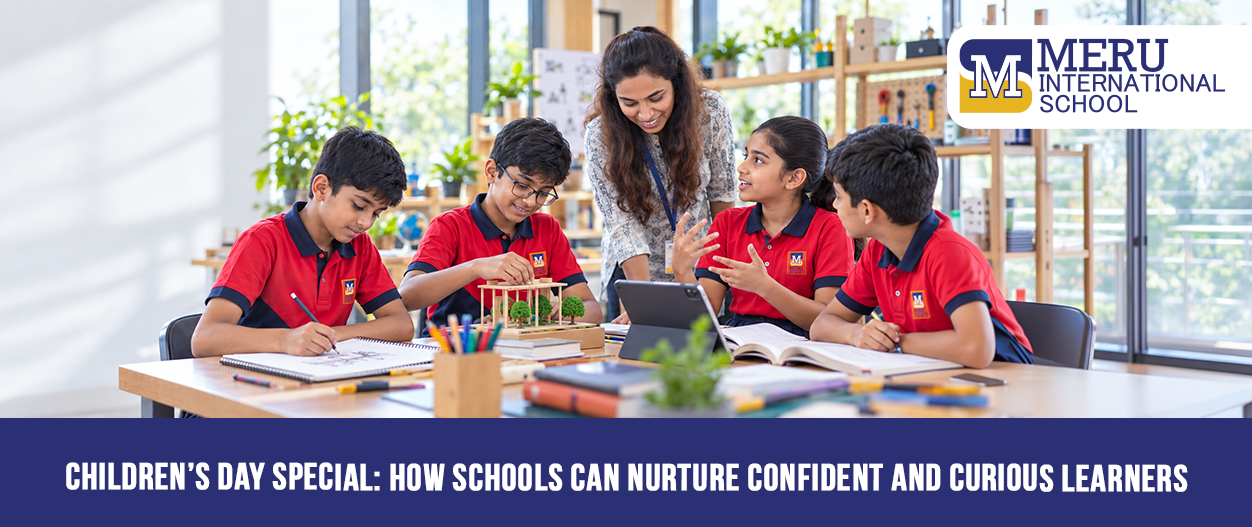
Children’s Day Special: How Schools Can Nurture Confident and Curious Learners
Children’s Day , celebrated on November 14 in India, is an opportunity to recognise children's potential, creativity, and individuality. Beyond celebrations and cultural programmes, the occasion encourages educators to reflect on how schools can create learning environments where every child feels valued, supported, and motivated to explore.
Self-respect and curiosity become two main qualities that make the learners independent in their learning process. Thanks to Children's Day, interesting classes, and support from school, the learners can develop these qualities.
Personalised and creative approach to learning helps the children realise their strengths and develop a constant interest in studying.
Why Confidence and Curiosity Matter in Child Development?
Confident children will talk more, engage in debates, do difficult tasks, and become independent in nature. A curious child will have the capability of asking questions, trying out ideas, and comprehending them beyond what is written in the book.
Both these traits complement each other. Confident children will be ready to learn about new things. Likewise, curiosity pushes them to try things and become comfortable with learning from mistakes.
It is the responsibility of the school to cultivate such qualities since they will enable them to develop a good learning environment.
How Schools Can Build Confidence in Students?
The building of self-confidence in children begins by recognising that all children are unique because each child has his or her own capabilities, preferences and learning needs.
There are some means through which teachers can build confidence in their students.
Encourage Active Participation
Ensure that children have chances to engage in debates, storytelling, group work, and presentations.
When children get motivated to speak out their thoughts, they eventually gain confidence.
Appreciate Effort and Progress
Acknowledging effort, progress, and perseverance will inspire students to continue learning.
In place of only giving emphasis to exam results, teachers can appreciate creativity, problem solving, collaboration, and personal accomplishments.
Create a Supportive Learning Environment
Kids need to be able to ask questions and make mistakes.
Giving constructive feedback, communicating respectfully, and developing good teacher-student relationships can lead to emotional safety and confidence.
Ways Teachers Can Encourage Curiosity and Creativity
Curiosity is developed when children are allowed to discover, experiment, and solve problems by themselves.
There are some ways in which teachers can develop curiosity in children, such as posing open-ended questions, holding interactive sessions, working on projects, and providing examples.
For instance, rather than simply telling them how plants grow, teachers may involve children in watching the germination of seeds, writing down the growth process of a specific plant, and discussing the factors affecting its growth.
Further, drawing, story-telling, drama, and model-making allow children to freely express themselves.
Champion Activity-Based and Play-Based Learning
Education becomes fun and interesting through activity-based and play-based education, where children are actively involved in the educational process.
Younger students learn counting from games, languages from storytelling, and science subjects from experiments.
Meanwhile, older students get involved in quizzes, debates, group activities, and challenging problems.
Such teaching methods help children learn how to communicate, think creatively, work in a team, and think independently.
The Class Of One (TCO1) provides online school education for children where they have to participate in interactive lessons and co-curricular activities.
The Role of Experiential and Inquiry-Based Learning
Experiential learning enables the learner to learn by experiencing, reflecting, and applying.
Inquiry learning entails asking questions, investigating possible alternatives, gathering information, and creating explanations.
Through such modes of learning, the learner will be able to relate the theoretical knowledge acquired in the classroom to practical situations.
For example, an activity related to budgeting could be used to teach mathematics and economics. A task on recycling could promote awareness about the environment and teamwork.
Through such experiences, the learner will be able to understand concepts and acquire necessary life skills.
Activities That Help Children Develop Essential Life Skills
Activities for communication, leadership, decision-making, and emotional development could be introduced by schools.
|
Activity |
Skills Developed |
Learning Outcome |
|
Storytelling |
Communication and creativity |
Confident expression |
|
Group discussions |
Listening and teamwork |
Collaborative thinking |
|
Science experiments |
Observation and problem-solving |
Practical understanding |
|
Art and craft |
Creativity and coordination |
Self-expression |
|
Role-playing |
Empathy and communication |
Social awareness |
|
Student-led projects |
Leadership and responsibility |
Independent decision-making |
These activities can be adapted based on the age and needs of the students.
Children's Day Activities for Schools
Enjoyment as well as education can go hand in hand in a Children’s Day Special event.
Some ways in which schools can plan activities for students to have fun while exploring their talents and interests include:
Talent displays: This activity will enable the children to showcase skills like music, dancing, arts, story telling, public speaking, etc.
Workshops: Painting, making crafts, and writing poems and stories are some of the activities that can be organised.
Discovery activities based on science: Experiments based on different subjects can be conducted in a fun way.
Classroom activities led by students: Children should be encouraged to explain certain topics, give presentations on projects, etc.
Games for team building: Games involving interaction and teamwork will enhance the communication skills of children.
Activities based on kindness and gratitude: It will involve children in expressing their gratitude.
For online schools, these activities can be conducted with the help of virtual performances, quiz, digital exhibits, online collaborations, etc.
Conclusion
Children’s Day is not just about celebration; it is also about the chance for educational institutions to acknowledge the potential in each child and instil confidence, curiosity, creativity, and critical thinking.
It is possible to do so by adopting positive and productive teaching methods along with experiential and interactive approaches and activities.
The Class Of One (TCO1) helps do so by providing individualised and online education, along with activity-based learning, interactive sessions, and co-curricular activities as well. With options available for art, music, dance, STEM, communications, and life skills, TCO1 aims to create an ideal learning environment for the development of academic as well as life skills in the children.
On this Children’s Day, it is about celebrating our children and encouraging them to ask questions, explore, challenge themselves, and have fun learning!

Comments
No comments available.
Post a Comment