
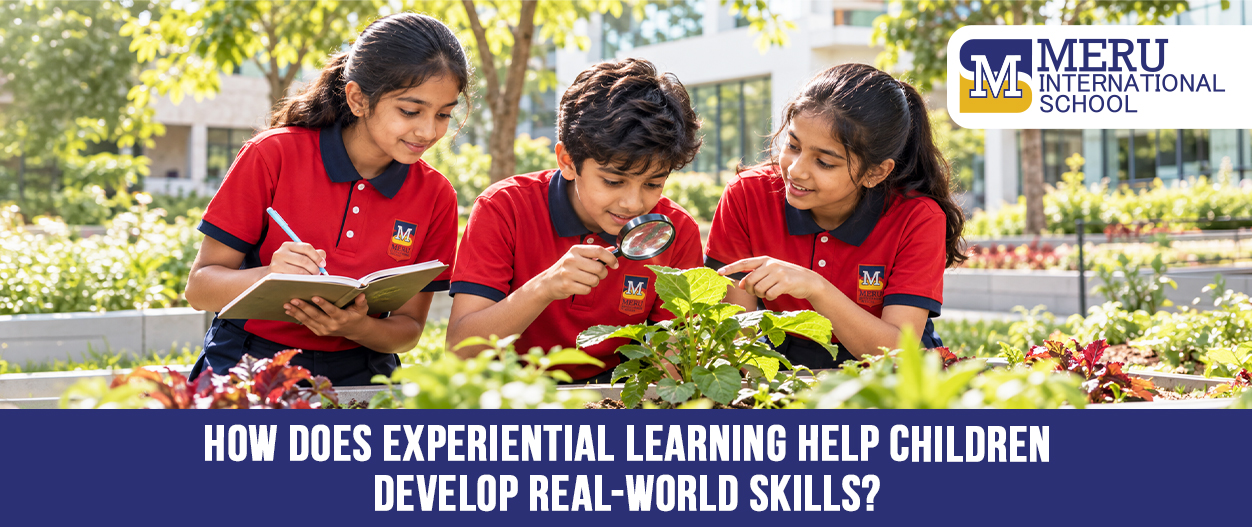
How Does Experiential Learning Help Children Develop Real-World Skills?
It is clear that children learn differently and for meaningful learning to happen, there must be more than books and teacher’s lectures. Experiential learning helps children have the chance to learn through doing, discovering, asking questions, reflecting on what has been done and using what has been learned in practical scenarios. Instead of just memorising the information, the students get involved in experiences that help them learn.
This learning style can take a number of forms including experiments and projects, field work, role playing, teamwork, community projects and challenges. Experiential learning can help the children improve their communication skills, collaboration, thinking, decision-making skills, creativity and flexibility.
What Is Experiential Learning?
What is experiential learning? To put it in simple terms, it is a type of learning where students learn from experiences and then reflect and apply those experiences to gain new skills. This is how the process of the Merus School’s experiential learning program is explained by stages of experience, reflection, dialogue, and understanding.
For example, instead of studying plants from a textbook, children can plant a small plant, observe the development of the plant, record the changes in the plant, analyse their experience and get to know the requirements for the development of the plant.
This type of learning will make things dynamic and students will learn how to apply theory to practice.
Understanding the Experiential Learning Approach
The experiential learning approach is a process of learning by doing. The child is made to pose questions, participate in activities, solve problems, collaborate and reflect on his/her experience.
Examples of a learning cycle include:
Experience –> Reflection –> Discussion –> Understanding –> Application
This will help students to progress from mere participation in the activity to the learning they have gained from the same.
For example, when it comes to a group project, the learners need to plan the activity, assign tasks, conduct research, resolve any conflicts, do the assignment, and present their work.
Why Is Experiential Learning Important?
One of the key factors contributing to the use of experiential learning is that children have an opportunity to put their knowledge into practice as opposed to memorising it.
The success of experiential learning is clear in its ability to inspire learners to apply their knowledge gained from new ideas and concepts, raise questions, make decisions, and analyse outcomes.
Experiential learning may help in the development of personal qualities such as effective communication, critical thinking, teamwork, flexibility, decision-making, and problem solving.
Types of Experiential Learning
There are several types of experiential learning that schools and parents can use to make education more practical.
|
Type of Experiential Learning |
Example |
Skills Developed |
|
Project-Based Learning |
Creating a model or research project |
Planning, research, teamwork |
|
Experiments |
Conducting a science experiment |
Observation, analysis, problem-solving |
|
Field Trips |
Visiting museums, farms or businesses |
Observation, communication, awareness |
|
Role-Playing |
Simulating real-life situations |
Communication, decision-making |
|
Group Activities |
Solving a challenge as a team |
Collaboration, leadership |
|
Community Projects |
Participating in a local initiative |
Responsibility, empathy |
|
STEM Activities |
Coding, robotics or engineering tasks |
Creativity, logical thinking |
|
Outdoor Learning |
Nature exploration |
Observation, adaptability |
What Are the Benefits of Experiential Learning for Children?
The benefits of experiential learning for children extend beyond academic understanding.
1. Develops Problem-Solving Skills
In practical activity, there are problems that children face and have to think about solving. This helps them analyse situations rather than looking for answers immediately.
2. Encourages Critical Thinking
Experiential learning can help learners ask questions, consider options, evaluate evidence, and make sound judgments.
3. Builds Communication Skills
Group projects, presentations, discussion, and role play give students the opportunity to share their ideas and listen to other people.
4. Promotes Collaboration
As kids cooperate, they understand the process of sharing tasks, communicating thoughts, dealing with conflicts, and participating in achieving a certain goal.
5. Encourages Creativity
Open-ended projects allow children to explore different approaches to a problem. They can play around with ideas and come up with original solutions.
6. Builds Confidence
Children may feel a sense of achievement from doing a practical job. Presenting the work or the explanation of the ideas can boost the confidence even more.
7. Develops Adaptability
However, sometimes things do not go according to the plan in real-world activities. It might be necessary for children to change their strategy, reflect on mistakes and try a different solution.
8. Makes Learning Meaningful
Learning can be more interesting when children can identify the relationship between the concept and an actual event that happens outside of the classroom setting.
Experiential Learning and Real-World Skills
Knowledge should always be put into use in practical situations within the modern world. Academic knowledge is very important; however, students should also have knowledge that will help them communicate, collaborate, make decisions, and handle problems and changes.
For example, a class-based activity in entrepreneurship will offer the chance to budget, plan, market, communicate, collaborate and make decisions. Science-based activities will help them develop observational, experimental, analytical and presentation skills.
A similar community-based activity will help the children develop responsibility, empathy, cooperation, and social awareness.
One of the biggest advantages of experiential learning is the connection between academic knowledge and practical experience.
How Can Parents Support Experiential Learning at Home?
Parents don’t need costly material things to promote experiential learning. Daily activities may be transformed into learning experiences for children.
Parents may encourage children to:
- Participate in planning a family meal to learn about measurements and budgeting.
- Garden and keep an observation diary.
- Organise their study table by themselves.
- Use measuring spoons when cooking.
- Prepare simple budgets for household expenses.
- Explore the topic of interest.
- Construct models out of recyclable materials.
- Prepare a family activity.
- Discuss the problem in the world and possible ways of solving it.
- Think about what was learnt after doing the activity.
Instead of giving immediate answers to their children, parents should ask such questions as "What do you think is going to happen?" "Why do you think it happened?" and "What would you try differently?"
Such questions help children think, experiment and reflect.
Does Experiential Learning Replace Academic Knowledge?
Not really. The need for experiential learning is not for it to replace academic learning. On the other hand, it can supplement academic learning by providing students with the opportunity to put their learning into practice.
For instance, in a mathematics class, one can learn about percentages, but then go out and apply the same to compute discounts when shopping. In a science class, one learns about ecosystems and then goes out and observes plants and insects, among other things.
Academic learning + practical application + reflection = complete learning experience.
Experiential Learning vs Traditional Learning
|
Aspect |
Experiential Learning |
Traditional Learning |
|
Student Role |
Active participant |
Often focused on receiving instruction |
|
Learning Method |
Doing, exploring and reflecting |
Listening, reading and practising |
|
Application |
Strong connection to real situations |
Application may come after instruction |
|
Skills |
Problem-solving, collaboration and creativity |
Knowledge and subject understanding |
|
Assessment |
Projects, activities and reflection can be included |
Tests and assignments are commonly used |
|
Learning Environment |
Classroom and real-world environments |
Primarily classroom-based |
Both methods may find a use in education. Experiential learning may support conventional classroom learning by enabling students to utilise the knowledge gained.
Why Experiential Learning Matters for Future-Ready Children?
The children will find themselves in situations in their higher education institutions, workplaces, communities, and even in their daily activities in which there won’t be an automatic way of responding. The children will need to socialise, solve problems, make decisions, assume responsibilities, and adapt to the changes.
Experiential learning gives the children a chance to develop these skills in an appropriate setting.
This can be done by adopting project based learning, field trips, experimentation, team work, sports, arts, and STEM in the school curriculum. This is not done for the sole purpose of making classes fun but for giving the children an opportunity to participate.
Conclusion
Through experiential learning, children may be able to get past their stage of memorising facts and get opportunities to experience, practice, question, reflect and understand. With the use of projects, experiments, outdoor activities, group work, STEM activities and everyday experiences, children are given opportunities to gain useful skills within and out of school.
Critical thinking, communication, collaboration, creativity, problem-solving, adaptability, and decision-making skills can all be developed through this approach while at the same time it is not used as a replacement for academic learning but as an opportunity to apply learning.
By concentrating on such topics as guides, FAQs, comparison pages, original insights, statistics, case studies and expertly-written content, Meru would be able to provide useful and comprehensive information for parents and teachers and create content formats which would have better chances of succeeding in search by artificial intelligence. Combining useful information with practical examples would also help to show how experiential learning can affect the academic and real life success of children

Comments
No comments available.
Post a Comment